

Do you remember those lists of overdue, unpaid invoices that came out on continuous paper with perforated strips on either side? Some people went to great lengths to tear off the strips because it looked “neater,” while others didn’t. It was a matter of style in the corporate world of the 1980s. We would then mark each line with a pencil to follow up on payment.
The point isn't to dwell on those who are nostalgic for that era—which is recent yet feels so distant in terms of technology. Back then, there was a lot of talk about holes: perforated printer paper, corded phones with rotary dials full of holes, punch clocks, and so on.

Collections were sometimes handled over the phone, but often involved snail mail and in-person visits to clients. Some companies—including some big names—employed tough guys who would set up shop in the lobby of the debtor’s office and wouldn’t leave until they had the check in hand.
The check, an archaic form of payment whose traces can still be found today, like fossils of outdated practices that are on the verge of extinction.
Sending a certified duplicate invoice used to take forever—between printing it, stamping it, having it signed by the authorized chief accountant, and mailing it with three-franc stamps.
So yes, things were better back then—simpler and certainly more human. But it was such a drag! Imagine having to work today using those methods, with that inevitable slowness that meant we got less done in a month than we do today in an hour.
I’ll admit it: I prefer today’s world—the speed of My DSO Manager, which lets you generate consolidated, real-time reports on groups operating around the globe in just a few moments. Experience the power that digital technology brings to client financial relationships. With just a few clicks on a screen, all the information and metrics are instantly drawn from data resources to provide the elements necessary and useful for decision-making. Send out intelligent mass follow-ups while personalizing specific cases, and optimize client risk management thanks to this magnificent marriage—when done right—of the human element and digital technology.
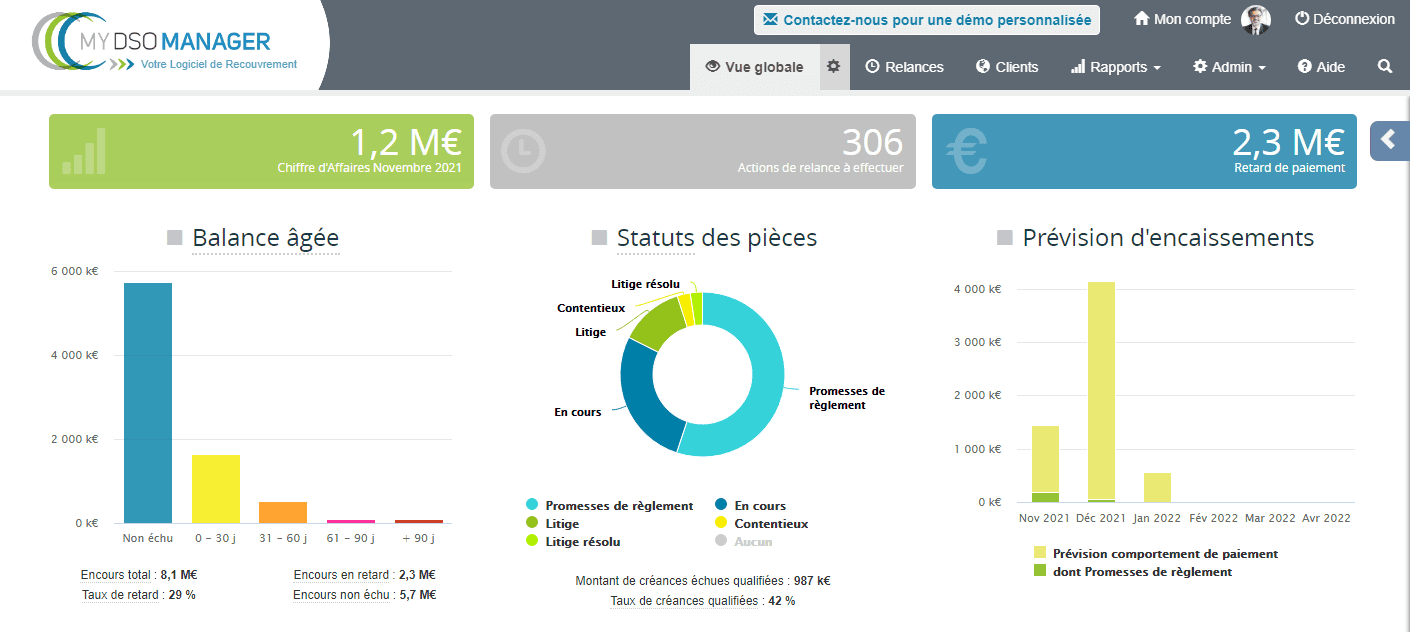
Instant sharing of massive amounts of secure information, immediate decision-making—digital technology, through its power, drives people to achieve much greater performance. Higher, faster, stronger, farther—this athletic metaphor applies to the credit manager who rides the wave of digital technology, harnessing its power with skill and agility to perform better—infinitely better—than in the 1980s. And on top of all that—the exponential improvement in performance and efficiency—what a thrill it is!
So yes, the digitization of customer relations is a reality—a trend that is futile to resist and one that offers many advantages and plenty of reasons to be enthusiastic. The same is true of the financial aspects of these relationships: customer risk, collections, and performance. Extremely challenging, digitization is an opportunity to contribute to the drastic transformation—the ongoing digital revolution—of the credit management industry and the economy in general. It calls for a level of dynamism previously unknown, requiring us to master challenges that are all the more significant given the limited time available to address them. Far from dehumanizing the customer relationship, it strips away the paperwork and bureaucracy to reveal its very essence: the art of communication and collaborative negotiation.
Author: Bertrand Mazuir, CEO of My DSO Manager