



Working capital is a management indicator used internally, and it also provides third parties with information on the company’s management performance.
What Is WCR? – Working Capital Requirement
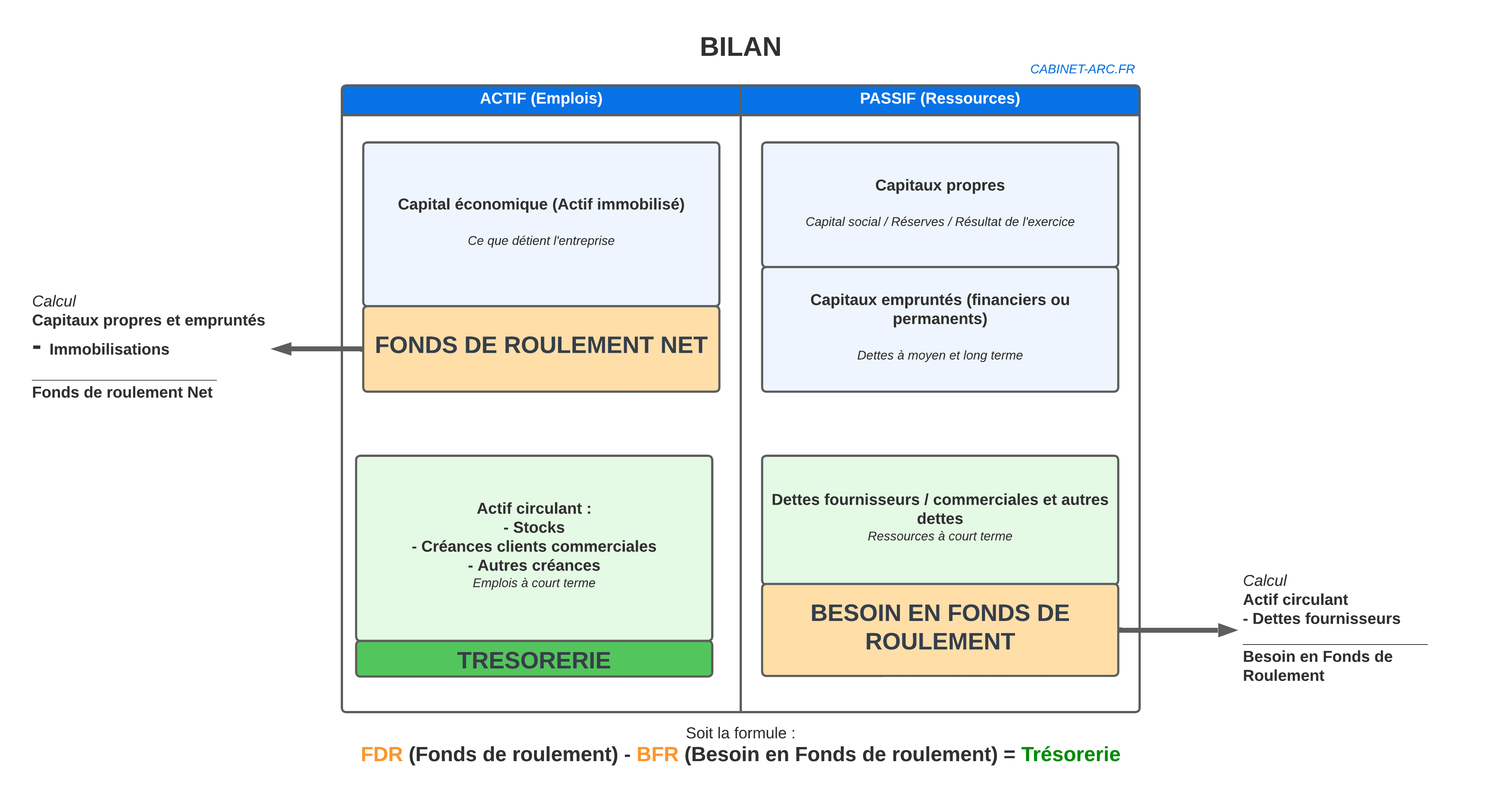
Working Capital (WC) is a management indicator that reflects a company’s financial autonomy. WC can only be assessed in relation to Working Capital Fund (WCF) —a structural indicator whose level indicates the surplus of stable capital relative to long-term uses. Working Capital (overall net) reflects management’s commitment to maintaining sufficient capital within the company to finance its operations with an adequate cash balance—without holding excessive cash reserves. This indicator clearly highlights the structural differences that exist between industry sectors, as well as those resulting from capital structures!
Along the same lines, one could also say that working capital is the financial expression of management’s ability to run their business, generate cash, and anticipate the future of their organization. The difference between net working capital and working capital is the company’s cash balance (which is calculated as follows: net working capital – working capital = cash balance).
How is working capital calculated?
Working capital consists of: operating working capital (BFRE) and non-operating working capital (BFRHE).
EBITDA is calculated by performing the following calculation on the company’s balance sheet: accounts receivable (including tax) + inventory – accounts payable (including tax) = EBITDA. This calculation can be expressed in euros, as a percentage of revenue, or—and this is particularly representative—in days of revenue.
Working capital (BFRHE) is calculated by performing the following calculation on the company’s balance sheet: other receivables – tax and social security liabilities – other liabilities = BFRHE. In practice, total working capital (BFR) is calculated by performing the following calculation on the company’s balance sheet: current assets – current liabilities = BFR.
To assess how a company manages its working capital, one can calculate changes in working capital (year-over-year or at regular intervals) by analyzing cash flows and their variations, which illustrate the company’s financial strategy. Cash flows indicate the sources of cash and the uses of those funds. This shows that the company’s operations can generate more or less cash and that the use of this cash either supports the growth strategy, is used to reduce debt, or meets shareholder expectations.
To track changes in working capital, the following turnover ratios are used: DSO for customers, DPO for suppliers, and DIO for inventory.
Why is working capital important?
There are two fundamental reasons for this: the company’s image, since it provides a snapshot of its financial reality and its actual and potential performance. Outside observers—including suppliers, for example—are very interested in this information.
It is also very important for a second reason that is internal to the company: working capital is a management tool.
Working capital is important to observers because it is an indicator of the quality of a company’s management. Indeed, by tracking its changes over time and comparing its level to that of companies in the same industry, one can determine, for example, whether accounts receivable are being managed effectively, whether suppliers are being paid on time, or whether inventory levels are reasonable. Changes in a company’s working capital foreshadow changes in its cash flow, unless the company asks shareholders to make equity contributions, forgo dividend payments, or asks banks to draw down on their credit lines—such as overdrafts or discount lines of credit.
This will allow all observers outside the company to assess the effectiveness of its management and its ability to generate cash—a key criterion for many financial investors and pension funds.

This will be yet another opportunity to demonstrate that the company has the internal capacity to generate its own financial independence, that it will be able to carry out external growth transactions using its own funds, or that it will be able to meet shareholders’ dividend requests…
But working capital is also important internally for managing the business, as it helps track performance and set goals for improvement. It provides insight into the company’s cash flow situation —without which the company cannot survive—and allows for the correction of any deviations.
Beyond being a management tool, working capital is also a tool for motivating teams and even for uniting all of the company’s employees around a common goal: cash!
Finally, the ratio of working capital to total assets indicates, for example, that the company is underutilizing the cash it structurally has available, or conversely, that it structurally lacks permanent capital and equity. This is important information for both external observers and the company’s internal managers.
When managing its working capital, the company must ensure compliance with laws governing payment terms in France, Europe, and internationally. It must also comply with applicable IAS/IFRS standards and apply the fair value principle when valuing current assets and short-term liabilities. This is critical to its reputation with third parties, its ethical standards, and the credibility of its financial reporting.